- Today in AI
- Posts
- OpenEvidence: The "ChatGPT" for doctors making $150M/year with ads
OpenEvidence: The "ChatGPT" for doctors making $150M/year with ads
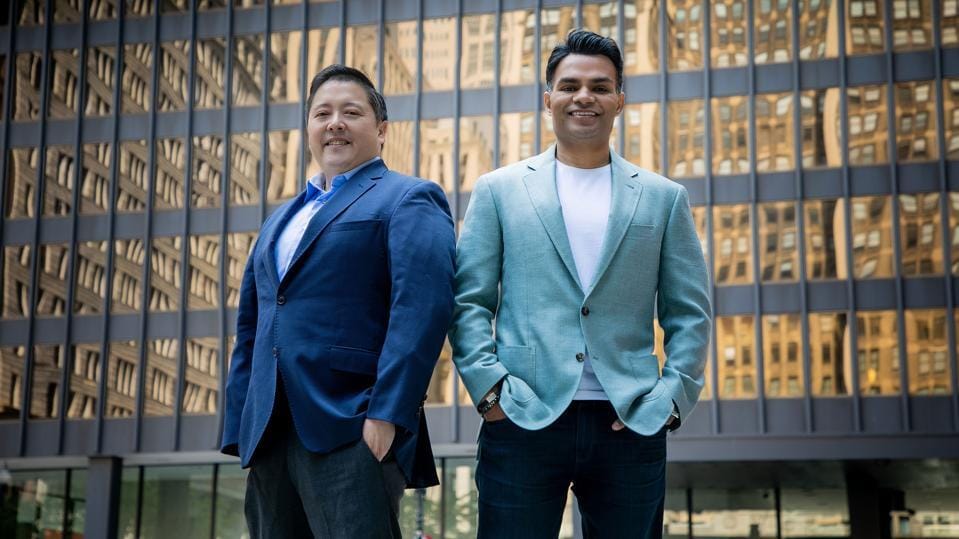
🤖 Meet Daniel Nadler: the Toronto-born founder at a $150M revenue run-rate with ads bringing verified AI to clinicians

Faizaan Mahmood
December 29, 2025
(6 minutes)
Hi 👋, this is the Today in AI Newsletter: The weekly newsletter bringing you one step closer to building your own startup.
We analyze a cool, industry-shaping AI startup every week, with a full breakdown of what they do, how they make money, how much they’ve raised, and the opportunity ahead.
Let’s get to the good stuff in this email:
💡 This startup is building the “ChatGPT for verified doctors”, with a mission to democratize medical knowledge for all clinicians.
📈 They’ve just hit 430,000+ registered U.S. physicians (about 40% of all U.S. doctors), and a $150M revenue run-rate on just ads
💰 They’ve already raised $495 million from Sequoia, GV & more, and are in talks to raise a further $250M at a $12B valuation
So what’s the startup and who are the founders behind it? Here’s the story of OpenEvidence 📈
OpenEvidence was founded by Daniel J. Nadler and Zack (Zachary) Ziegler in 2022.
It’s a clinical search engine designed to turn a doctor’s question into an evidence-grounded answer, using citations from gold-standard medical sources.
OpenEvidence uses an “open-book exam” approach instead of relying on a model’s internal weights as the source of truth.
It uses a cooperative ensemble of half a dozen specialized PhD-level models for retrieval, ranking, and synthesis.
To reduce hallucinations, it was trained with no connection to the public internet, avoiding misinformation from blogs and social media.
It relies on partnerships with NEJM, JAMA (American Medical Association), NCCN, and the American College of Cardiology.
OpenEvidence is completely free for physicians and monetizes through highly regulated medical advertising, compared to ad-supported platforms like Google or Facebook.
And they’re printing from ads…
Latest features and best use cases 🧑⚕️
Visits supports patient encounters with real-time medical intelligence, evidence-backed transcription, and clinical note drafting.
DeepConsult synthesizes findings across multiple studies for complex clinical reasoning.
Document Analysis lets doctors upload and analyze text-based documents inside conversations, including de-identified histories or past records.
A “Why Was This Source Cited?” feature lets doctors audit why a reference was used.
The product is positioned as most useful for complex “long-tail” cases, used at the point of care for questions like drug interactions, and current protocols.
Backstory: Kensho, poetry, and film 🎬
Daniel J. Nadler was born in Toronto, Ontario in 1983, the son of immigrants from Poland and Romania.
His father was an engineer who used sound to detect microscopic cracks in structures like submarines and bridges.
Nadler attended Harvard, studying mathematics, classics, and poetry under Pulitzer Prize winner Jorie Graham. In 2016, he earned a PhD in Econometrics from Harvard, focused on pricing mechanisms of credit derivatives.
While still a PhD student in 2013, Nadler co-founded Kensho Technologies with Peter Kruskall.
The idea came from Nadler’s time as a visiting scholar at the U.S. Federal Reserve during the financial crisis, where he saw the Fed had an “unlimited budget” for tech but lacked tools to connect heterogeneous event-driven data (like geopolitical disturbances or weather phenomena) to macro assets.
He spent months persuading Google Ventures to back Kensho, then spun it out with a team of Google engineers.
Kensho became the largest provider of risk analytics to the global banking system and powered 80% of televised business media analytics on CNBC.
In 2018, S&P Global acquired Kensho for $550M, described as making it the most valuable privately owned AI company in history at the time.
Outside tech, Nadler published a debut poetry collection, Lacunae: 100 Imagined Ancient Love Poems (published 2016), named a Best Book of the Year by NPR.
In 2018, he became the youngest person ever elected to the Board of Directors of the Academy of American Poets.
He also co-financed and served as an executive producer on the 2019 film Motherless Brooklyn and the 2021 drama Palmer, starring Justin Timberlake.
The Hustle 🤑
After the sale of Kensho, Nadler experienced burnout.
During COVID-19, he shifted focus toward medicine, describing biotechnology as a “golden age” while physicians were in a “dark age” of information overload and burnout.
He framed the problem with a specific trend: in 1950, medical knowledge doubled every 50 years, and now it doubles every 5 years, with two new papers published every minute.
Nadler founded OpenEvidence in 2022 with Zack Ziegler - an “elite Harvard ML researcher.”
He funded the first $10M himself to keep a roughly 60% equity stake.
He avoided a “top-down” healthcare sales model with 18-month cycles and “responsible AI committees,” and instead used a direct-to-clinician strategy: doctors treated like consumers, a free App Store product, and 100% word-of-mouth growth spreading between doctors on hospital floors.
Advertising inside AI chatbots & agents 📣
Most AI chatbot products avoid ads because people assume ads would destroy trust and retention. One recent experiment suggests that assumption is weak.
A company put advertisements inside a coding agent used by senior engineers at serious enterprises. The internet did not explode. The product generated $5M to $10M in annualized revenue within a month.
This matters for OpenEvidence because it already runs on highly regulated medical advertising. It’s an example of a chatbot interface funding mass distribution with ads.
According to Arfur Rock, they’re winning with ads already:
$150M revenue run-rate from ads, up 3x since August, on under 1M users.
~90% gross margin, explicitly stated as including all compute.
He then said that 2026 is when AI ads “cross the rubicon,”:
Why this matters (and what to copy):
If those unit economics are even directionally right, it strengthens the idea that ads can work inside AI products when:
1. The user intent is high,
2. Ads are clearly separated from the model’s answers
It also reinforces a broader pattern: ads are starting to look like the default business model for AI interfaces that people use many times per day, especially when the product is expensive to serve and needs a path to mass distribution.
Stats 📊
Fast forward to today, OpenEvidence has 430,000+ registered U.S. physicians (about 40% of all U.S. doctors).
They’re growing at ~65,000 new verified doctors/month, and have done 17 million consultations in October 2025 alone.
This year, OpenEvidence is on track to impact care for 100M+ Americans.
According to Arfur Rock, they’re at a $150M revenue run-rate with 90% gross margins including all compute. This run rate is up 3x from August…
On LinkedIn they have 91 “associated members” so I’m assuming 60-70 employees.
In October 2025, OpenEvidence raised a $200M Series C at a $6B valuation led by Google Ventures with participation from Sequoia Capital, Kleiner Perkins, Blackstone, Thrive Capital & more, bringing their total raised to $495+ million.
According to Arfur Rock on X, OpenEvidence is now in talks to raise another $250M at a $12B valuation…
Before you go 👋
Thank you for reading. Know someone who’d love this newsletter? Share the love. 🌟
🚀 Building something in AI? Get featured in front of 100,000+ founders, builders, and investors. 👉 [email protected]